
Red Sea Shipping Disruptions 2026: Suez Canal Routes & Freight Alternatives
Red Sea disruptions are changing how importers and exporters plan shipments in 2026. Explore Suez Canal routes, ocean freight, road transport, air freight, and flexible logistics options.
Tranzita Editorial Team
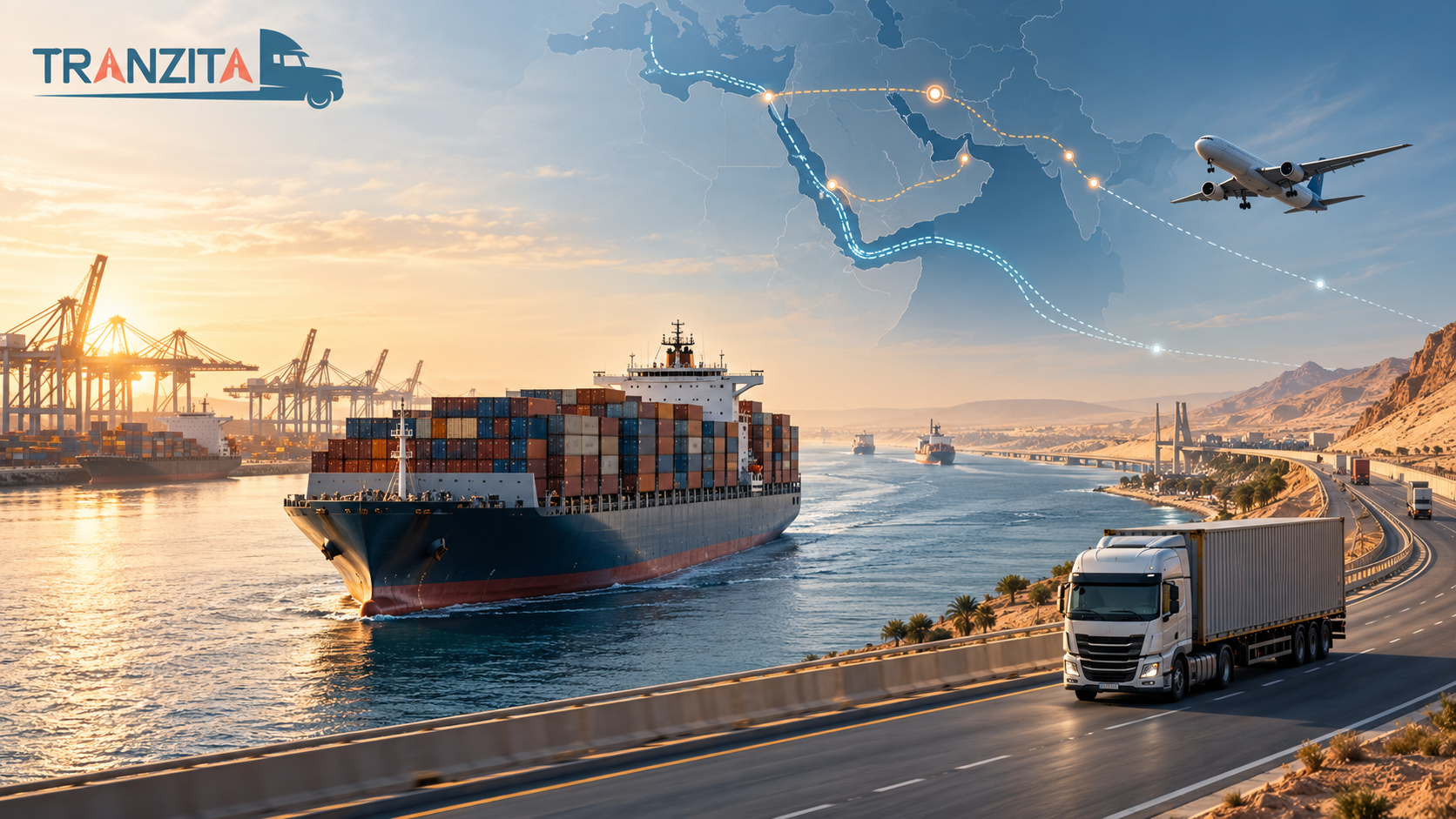
In 2026, disruptions in the Red Sea are shaping how shippers plan voyages. Many cargo teams now focus less on one number.
The first question used to be: What is the freight rate?
In 2026, what is going on with Red Sea and Suez canal shipping?
In the later part of 2026, several big container carriers started to reroute some services back to the Red Sea and Suez corridor.
Maersk and Hapag-Lloyd both said they made structural edits to some Gemini Cooperation services. The list includes AE5, AE11, AE12, and ME2. These moves shift the routes off the Cape of Good Hope and onto the trans-Suez line. Maersk said the goal was better transit timing. It also noted that the plan depends on how stable the region stays. Maersk said this in its announcement.
Hapag-Lloyd also confirmed more sailings through Suez and the Red Sea. Its steps are not all at once. The company said the changes are done by service. It also made clear that this is not a complete comeback of its full network to the Red Sea. Each sailing still needs a security check. Hapag-Lloyd
Even so, concerns near Bab el-Mandeb are still a major issue. Recent events have shown how exposed shipping traffic can be in that area. European governments have pushed for stronger measures to protect ships as they pass through the strait. Reuters
The short version
Some trans-Suez services are coming back in stages. But conditions on the water keep changing.
Why this affects importers and exporters
If you plan a new shipment, you need to expect shifts.
Why Red Sea shipping matters for firms in Egypt
Egypt is placed along one of the key trade routes on earth.
Any change in the Red Sea or the Suez canal can hit companies that move goods by sea, including those that ship:
- between Asia and Egypt
- from China to Egypt
- between Egypt and GCC countries
- between Egypt and Europe
- through Egyptian ports
- through regional transshipment routes
Now it is more often: Which route fits this shipment best, given what is happening right now?
Ongoing tension near the Red Sea and at Bab el-Mandeb keeps changing the picture. Because of that, companies pay closer attention to route planning and backup options. Importers, exporters, makers, and logistics groups all feel this shift in daily decisions.
Some shipping services have also started to come back to the Red Sea and the Suez Canal path. This follows a period when many vessels relied more on routes through the Cape of Good Hope.
Still, you cannot treat it as a clear switch. It is not as easy as saying Suez is fully back. It also is not correct to say the Red Sea cannot be used anymore.
The best choice depends on several factors, including: whether the route is actually open, what kind of cargo it is, how fast it must arrive, total cost, how urgent the shipment is, the chance of delays or other trouble, and what alternate lanes are available.
The Suez Canal links Asia to Europe in a faster way than sending ships around the Cape of Good Hope.
That shorter path is one reason some big carriers are bringing certain Suez services back. They do this only when their security checks are satisfied.
For instance, Maersk said that running MECL again through the trans-Suez line could cut the trip time by about seven days for westbound moves and about fourteen days for eastbound moves, versus the longer Cape option. Maersk
But travel time is not the whole story.
Firms also need to look at more items, such as:
- how steady the timetable is
- whether the route stays the same
- where the cargo changes ships
- what the insurance terms say
- any extra fees and charges
- how often the ship stops at ports
- how fast the cargo must move
- any needs for inland transport
Is Ocean Freight Still Worth It?
For many shipments, it is.
Ocean freight often fits well for:
- boxed goods
- big shipment volumes
- raw materials
- items for industry
- routine inbound demand
- loads that do not need fast delivery
- heavy cargo
For many companies, ocean freight can be a strong choice when you must move a lot at a lower cost and still scale up.
Still, in 2026, the comparison should not be just: Ocean freight vs air freight
You can also frame it like: Sea route A vs sea route B
Or: Sea plus road
Or: Road freight only
Or: Use air for the urgent part and sea for the rest
This is where planning has to stay flexible.
When Does Another Sea Route Help?
A different ocean route may work better when the usual service is disrupted by:
- route changes and instability
- weaker schedule performance
- longer waits along the way
- changes in how carriers rotate
- fewer equipment options
- rules that limit operations
In some cases, a company may decide to:
- use a different carrier
- pick a different port to load from
- choose another discharge port
- switch the transshipment stop
-a longer but more stable service
The better choice is the whole logistics picture, not just the ocean line item. You have to look at all of it, including cost and time. Freight cost alone can mislead you.
Key items to include: freight cost transit time transshipment risk inland trucking cargo handling delivery requirements
Can road transport work instead?
Yes, for some lanes it can.
This often fits shipments moving between Egypt and GCC markets. It can also fit other spots you can reach by road in the same region.
On those lanes, road freight may offer: movement without extra legs in some cases fewer handoffs pickup and delivery that can be adjusted door to door service more control over parts of the route a fallback when ocean service turns more uncertain
Still, one caution: Road freight is not always cheaper. It is also not a sure win in every case.
Sometimes sea freight costs less. Even then, a company may still choose road when: time matters more than the price the cargo needs a more direct path flexible delivery is a must tight control over the process is important the ocean option is harder to plan right now
This can apply to shipments between Egypt and: Saudi Arabia UAE Qatar Kuwait Bahrain Oman The final call depends on cargo type, the lane, border rules, timing, and what equipment is needed.
When does air shipping fit?
Air freight is not the default swap for every shipment. It matters most when the cost of delay is bigger than the added freight cost.
Typical cases: urgent spare parts parts needed to keep a line going high value cargo electronics critical industrial shipments medical freight time sensitive business orders samples
In these cases, the question should not only ask:
“Is air freight expensive?”
Try this instead: “What will the delay do to the business?”
One option that often helps is splitting the load. For instance: Urgent items go by air. The rest can move by ocean.
That approach keeps key work running, while the full shipping bill stays under control.
What does flexible logistics planning mean?
It is not about changing routes every day. It is about having backup options ready first.
Have this set before any disruption: a main plan a second route a backup transport method
For each shipment, check the items below.
Factor | Key question Route | Which routes can we use right now? Time | When must the goods arrive? Cost | What is the full logistics cost? Cargo | Does the shipment need special handling? Risk | Where could the trip get blocked or slowed? Alternative | What is the Plan B? Visibility | How will we track the shipment?
This shifts logistics from last minute fixes to planned follow through.
Before you book a shipment right now, check these points.
#### 1) Does the transit time quote still make sense?
Do not trust only the usual listed transit window. Confirm the details that can shift fast:
- the current rotation
- the real route
- where the cargo is transferred
- any recent timetable edits
- the time you may need to wait at key stops
#### 2) Will the plan go through the Suez Canal or around the Cape?
That choice can change several things:
- how long the trip takes
- how much time the fuel risk window is open
- how steady the schedule stays
- what extra charges show up
- whether containers are easy to get
- how your supply plan needs to be timed
Some big lines are moving back toward Suez. Still, the path can differ by line and by service.
#### 3) Can international road freight work instead?
For cargo that stays within a region, it may help to compare options: Ocean freight vs international road freight.
Do the math using the full cost, not just the main freight rate. Include items like:
- pickup cost
- border work
- waiting time
- delivery cost
- inland trucking
- how urgent the cargo is
In a few cases, road can run smoother day to day, even if the headline rate looks higher.
#### 4) Should part of the load move by air?
You might not need to use only one transport type for the whole move.
Some shippers split the move, for example: Air plus sea, or Air plus road.
Pick this based on what matters most for your business right now.
#### 5. What If Conditions Shift After You Book?
This matters a lot in 2026.
Before you confirm anything, check these points:
- the backup route
- whether the shipping type can change
- what the price impact could be
- how the arrival time might move
- who will manage the backup plan
- how you will get new updates
Logistics Planning Now Sits Inside Supply Chain Risk Work
Recent issues in the Red Sea highlighted a clear point: resilience is not just a theory anymore.
Shippers and makers, plus distributors and exporters, should build plans that include: Primary route, then an alternative route Also, an alternative way to move the cargo
This is most useful when your cargo ties into:
- keeping production running
- meeting customer delivery promises
- seasonal demand swings
- export contract terms
- goods that can spoil
- stock that must stay on hand
- key spare parts
The goal is not to forecast every problem. The goal is to not begin from scratch when it happens.
How Tranzita Supports the Right Shipping Choice
At Tranzita, we start by looking closely at the shipment.
We focus on details like: Origin Destination Cargo type Weight or volume Readiness date Delivery deadline How urgent it is Any special needs
After that, we can compare the options.
Ocean Freight
Often a good fit when size, cost control, and cargo needs point to sea transport.
International Road Freight
Works well for regional moves, especially when you want direct travel, more routing options, or easier cross border handling.
Air Freight
Best for time critical freight, when speed matters more than the transport cost.
Inland Transportation
Used when cargo needs to move between ports, airports, factories, warehouses, distribution sites, and the last delivery point.
Customs Clearance and Documentation
Helps cargo clear the border. It also supports import and export steps, plus the paperwork tied to each shipment.
Technology’s job is to show what is happening during the journey. Tranzita uses digital tools and a dashboard to help with that.
Consultation then planning, then coordination, then execution, then visibility
What is the best shipping choice right now?
There is no one answer for every move.
Ocean freight can work well for bigger shipment volumes. International road freight can be more flexible on some regional lanes. Air freight can fit when delivery speed matters most.
The right logistics call depends on: Cargo, route, time, cost, risk, urgency
This is a practical way to plan freight when things can change fast.
Frequently Asked Questions
Has container shipping fully come back through the Suez Canal in 2026?
No. Some services are returning step by step to the Suez and Red Sea route. Still, major carriers such as Hapag-Lloyd say the return is gradual and depends on the specific service, not a full rebuild of the whole network. Hapag-Lloyd
Why are carriers going back to the Suez Canal?
For many Asia to Europe routes, the Suez path is shorter and often more efficient than going around the Cape of Good Hope. Maersk points to faster transit times as one of the main reasons for bringing selected services back to the trans-Suez corridor.
Can road freight work for Egypt to the GCC instead of shipping by sea?
For some loads, yes. It depends on where the cargo is going and what it is. It also depends on how heavy the shipment is, the route, the delivery date, and what is needed at the border. Total logistics cost also plays a key role.
Road or ocean, which one wins?
There is no single best option. Ocean freight often fits bigger volumes. Road freight can help when the route needs flexibility or when a shipper wants tighter control on parts of the trip.
When does a firm use air freight?
Use air when the delivery time is very tight. If delays cost more than the extra air freight charge, air may be the better choice. This can apply to urgent spare parts, high value goods, key industrial parts, or sales shipments that must arrive fast.
How do companies pick the right mode?
Look at more than the price per shipment. Check the route and the total time. Review the full cost. Consider the cargo type and the operational risks. Also review urgency and what other options are available.
Bottom line: being flexible helps most.
Today’s logistics reality favors companies that plan more than one way to ship. A good plan should not rely on just one route, one company, or one transport method. It should allow changes when conditions shift.
In practice, that might mean: Ocean for one shipment Road for another shipment Air only for items that must move right away Or a mix of these methods
The goal stays the same. Get the cargo moved with the option that fits the real business need.
Want us to review your shipping choices?
Send the details: Origin and destination Cargo type Weight and or volume Ready date Target delivery date How urgent it is
The Tranzita team can look through the options with you and help set a practical execution plan.
📞 01024248858 🌐 tranzita.app
Tranzita — One platform. Every route.